Early Walsh History in Ireland
Rise and Fall
WALSH 1170-1690
Between the years 1170 and 1690 the family of Walsh (Walshe) in Ireland
contributed their share to the making of the history of that country.
They came from Wales, at the time of the Cambro-Norman invasion into Ireland
led by, among others, Richard FitzGilbert De Clare, Earl of Pembroke (also known as
"Strongbow"), Raymond Carew (known as "Le Gros"), Gerald FitzMaurice and
Robert FitzStephen.
'Norman' was a term applied to those Vikings who conquered parts of
Northern France beginning in 911 A.D. Their progeny invaded England in 1066 and arrived in
Ireland in 1169 landing at Bannow Bay, Co. Wexford.
It is written that the help of these Cambro-Norman knights was summoned by the Leinster king
Dermot MacMurrough to help reclaim his kingdom. Henry II of England followed in the year 1171.
Further reference:
Cambro-Norman Invasion of Ireland.
The Walsh relationship with the Cambro-Normans (from Wales) can be
seen to have been the determining factor in their acquisition of property
in Ireland. Their good fortune and their reverses are seen to have been
bound up with the struggles of the Fitzgeralds, Butlers, and Burkes for
pre-eminence in power and possession, and with the desperate efforts of
the English governors to hold a small area around Dublin [the Pale] against the
pressure increasingly exerted by the native Irish.
From the very first year of their arrival in Ireland the Walshs, and all
their associates, were regarded as English by the Irish, and as Irish by the
English, and after five centuries this was still the position by reason
of the continuous operation of two conflicting tendencies. English law
was cleverly designed to keep them at enmity with the old Irish; yet the
conditions in which they lived conduced to friendship and intermarriage
with their Irish neighbors.
There was much in common between the early Welsh and the Irish. They were of the
same Gaelic stock, and had the same system of selecting rulers by tanistry.
Both would set aside the eldest son of a chief from the succession for even a
physical blemish, both took hostages from defeated enemies, and both made a
practice of blinding possible rivals. The Welsh were also, as the Irish were
not, guilty of mutilation for the same object. In times of trouble the Welsh
chieftains found refuge in Ireland, and the Irish chiefs in trouble were welcome
in Wales. Of all who went to Ireland following the Cambro-Norman Invasion, those of
Welsh blood were most likely to accommodate themselves with ease to the
new conditions.
As to the family origin of the first who went to Ireland, it seems clear that
they were drawn from the leading houses of Wales. Ririd, who settled in Dublin
County, was a son of Owen Gwynned, Prince of North Wales; and a brother of
David, Owen's son and successor. There is some indication that David, son of
this David, also went there. Philip FitzRhys was clearly of the house of South
Wales. Philip and David "Walsh", who are mentioned in the early histories, and for
whom it is claimed that both Strongbow and Raymond le Gros were their
uncles, appear to
be with the Geraldines rather than with the de Clares. In the early years
they were very close to the Fitzgeralds, and Meyler Fitz Henry was their
constant friend. Other families of le Waleys (Walshs) undoubtedly descended
from Cadwallader, brother of Owen Gwynned, and Alicia de Clare, but the
indications are that they came later to Ireland.
Read more at Exploring Walsh Connections in Wales.
When Henry II arrived at Waterford, late in October, 1171, Dermot McCarthy
of Ireland went of his own accord to pay homage, give hostages, and agree
to pay tribute for his kingdom. In 1173, the invaders broke out of their initial Leinster
foothld and invaded McCarthy's territory at Lismore. It was in escaping with their
spoils that they met the Danes of Cork, where Philip 'Walsh'
was the victor (see Walsh of the Mountain). At
about the same time Raymond le Gros defeated McCarthy on land.
Then, in 1175, after the siege of Limerick, where David Walsh attracted
attention, Raymond was appealed on behalf of Dermot McCarthy, who had been
imprisoned by his son Cormac. Dermot's envoys, in imploring Raymond's aid,
promised him large gifts. By a sudden move on Cork, Raymond succeeded in
restoring Dermot to his kingdom, and he was given by the grateful Dermot
lands of large tracts in Kerry. Ultimately, through the favor of
Raymond, and marrying into the McCarthy families, David Walsh
obtained land in Kerry and Tipperary, and Philip Walsh obtained mountain land
in Waterford and Tipperary. There was nothing revolutionary about these
McCarthy marriages with young men of royal blood of Wales.
There is a natural tendency to ascribe to David and Philip Walsh a patriarchal relation
to the whole family of Walsh; but obviously that is a conclusion difficult to
justify. The WALSH name, as it appears in the records in various places throughout Ireland,
at first is seen as Wallensis, then as Waleys, then in the Irish form Brenagh, and finally as Walsh, Brannagh, et al.
Read more about Walsh Surname Origins.
It is more than a little curious how these early arrivals from Wales seemed to
gravitate to the mountains. It was natural enough, no doubt,
 that they should
like the kind of country they came from, but the more likely explanation is
that they were chosen, in those early fighting years, for their value in
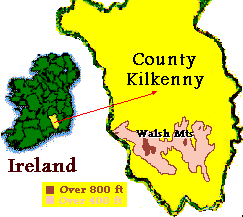
mountain warfare. A relief map of Kilkenny shows a great level plain between
two ranges of hills. On the plain there were no Walshs; the mountain country
to the south was filled with them.
Castlehale
itself stood on the northern
edge of the mountain land, with a wide outlook across the plain. It was the
same in Dublin and in Wicklow. For five full centuries the Walshs were in the
mountains there, posted at points commanding the mountain passes. They were
in the Comeragh Mountains in Waterford, and had their castles on the
mountain flanks. They were on Carrickbyrne in Wexford. They were in the
mountains of Kerry. They thrived in these places and were a sturdy stock.
that they should
like the kind of country they came from, but the more likely explanation is
that they were chosen, in those early fighting years, for their value in
mountain warfare. A relief map of Kilkenny shows a great level plain between
two ranges of hills. On the plain there were no Walshs; the mountain country
to the south was filled with them.
Castlehale
itself stood on the northern
edge of the mountain land, with a wide outlook across the plain. It was the
same in Dublin and in Wicklow. For five full centuries the Walshs were in the
mountains there, posted at points commanding the mountain passes. They were
in the Comeragh Mountains in Waterford, and had their castles on the
mountain flanks. They were on Carrickbyrne in Wexford. They were in the
mountains of Kerry. They thrived in these places and were a sturdy stock.
Much later in the 17th century, Cromwell's armies were in Ireland and methodically
removed all vestiges of the Walsh landholders. In Waterford, Sir Nicholas
Walsh made a good fight and was killed. In Kilkenny, Walter Walsh fought,
Castlehale was destroyed, his men were massacred and buried in a single
pit, and he died sitting at table. In Dublin, Carrickmines was stormed and
blown up, its garrison massacred, and Theobold, a "captain of the Irish"
attainted. The head of the Walshs of Rathronan in Tipperary was in the fight,
and so were the Walshs of Kerry. They all lost everything. Cromwell was very
thorough.
The Cromwell confiscations in Kilkenny County in 1653
accounted for 18,000 acres of
Walsh property, of which 14,000 was that of the Baron of Shancaher in the Walsh
Mountains. Another 1500 acres in Kilkenny and 12,000 in Waterford were the
property of Walsh of Piltown, who died in the fight for his home. Castle Hale,
the seat of the Lords of the Mountain,
and Piltown, chief seat of the other
family, have disappeared even from the map. Another Waterford family, called
"Walsh of the Island", prosperous merchants in Waterford City, also lost,
besides their business, about 3000 acres of land, of which 1200 were in their
country seat at Ballygunner. Still another family had large possessions in
eastern Cork, near Youghal, and others in eastern Kerry. Other thousands of
acres changed hands in Dublin, Wicklow, Kildare, Wexford, and though less is
known, in western Cork and Tipperary. For further reference see
Confiscations.
About the year 1800 a gentleman named Tighe made a statistical survey of
the county of Kilkenny. He writes, "The most considerable dairies are in
the Welsh Mountains, in Irish sliegh "Brenoch", and are supposed to
take their name from the family of Welsh, or Walshe, by whom a large tract
of country was formerly possessed. 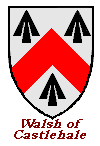 The first of this family is said to have
come to Ireland with FitzStephen and his successors, and to have had afterwards
eighteen houses or castles in this district..."
The first of this family is said to have
come to Ireland with FitzStephen and his successors, and to have had afterwards
eighteen houses or castles in this district..."
"To the Walshs belonged, probably, the castles of Inchicaran,
CastleHale, Earlsrath, Munshall's Court, Ballynony, Ballinlea,
Kilcraggan, Ballybokan, Corbally, Castlegannon, New Castle,
Ballybruskin, Knockmoylan, Lismateige, Ballybregan, Ballynacooly,
Grange Castle, and some others."
Further reference: Place Names of the Family of Walsh.
Source: Notes taken from the book "WALSH 1170-1690"
A quote from a former "Welcome to Medieval Kilkenny" web site said...
"Scenic Drive - Driving through Piltown takes one through one of the most
scenic areas in all Kilkenny. As one drives from Templeorum to Mullinavat
across the southern slopes of the Walsh Mountains the views of the Suir
Valley are truly spectacular and extensive and this is also the route
reputedly taken by Cromwell on his march to Carrick from New Ross."
The preceding article was compiled by Dennis J. Walsh, © 2009
Walshs in the Early Irish Counties.
Walsh Surname - Origins of the Walsh Surname.
Walsh Arms - Variations on Walsh Coats of Arms.
Wales - Exploring Walsh Connections in Wales.
England - Early Walshs in England.
France - The French Connection.
Possible Pedigrees - of the early Walshs in Ireland.
Calendar of Ormond Deeds - 13th to 15th century.
Biographies - Short Bio's on notable Walshs, plus links to online Bios.
Place Names - Historical place-names of the family of Walsh.
Walsh of Kilkenny - Historical Perspective
Confiscations - of Walsh land holdings in Ireland at the time of Cromwell.
Lament of John MacWalter - Irish caoine about Walsh of the Mountain.
